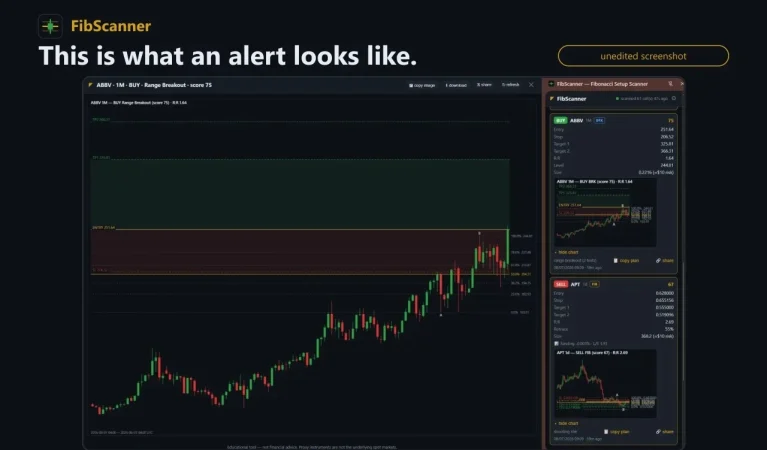
A Fibonacci Setup Scanner is a trading tool that helps traders identify potential market setups based on Fibonacci retracement and extension levels. Instead of manually checking multiple charts, traders can use a scanner to search for technical conditions across different assets and timeframes.
Fibonacci levels often help traders study areas where price may pause, retrace, or continue its existing movement. Common levels include 23.6%, 38.2%, 50%, 61.8%, and 78.6%. A scanner can make this analysis more efficient by highlighting charts where price action is interacting with important Fibonacci zones.
The main purpose is not to predict the market with certainty. Instead, the scanner organizes technical information so traders can examine possible opportunities more quickly.
How Does a Fibonacci Scanner Save Time?
Manual chart analysis can take considerable time, especially when traders follow several currency pairs, stocks, indices, or other markets. Checking every chart individually may cause traders to overlook setups or spend too much time searching for them.
A Fibonacci Setup Scanner can automate part of this screening process. It can scan selected markets and identify charts that match predefined Fibonacci conditions. This allows traders to focus their attention on a smaller group of potentially relevant setups.
For example, a trader may want to find markets where price has retraced toward a particular Fibonacci level after a strong price movement. Rather than opening dozens of charts, the scanner can help identify charts that deserve closer examination.
Can a Fibonacci Setup Scanner Improve Market Organization?
Yes. One useful benefit of a scanner is better organization.
Traders often monitor several instruments and timeframes. Without a structured process, it can become difficult to remember which charts have already been checked and which ones may require further analysis.
A scanner can create a more systematic workflow. Traders can define the markets, timeframes, and technical conditions they want to monitor. The resulting signals can then serve as a starting point for deeper analysis.
This approach can reduce unnecessary chart switching and help traders maintain a consistent screening routine.
What Role Does a Non-Repainting Fibonacci Scanner Play?
A Non-repainting Fibonacci scanner is designed to avoid changing historical signals after new market data becomes available. This distinction matters because traders need to understand how a technical signal behaved when it originally appeared.
In technical analysis, repainting can make historical results look more reliable than they were in real time. If a signal changes after subsequent price movement, a trader reviewing the chart later may see a setup that was not actually available in the same form at the earlier moment.
A Non-repainting Fibonacci scanner aims to provide more stable historical signals. However, traders should still examine how the specific tool defines its calculations, confirmation rules, and swing points. “Non-repainting” does not mean that every signal will become profitable.
How Can Scanners Help Traders Find Multiple Setups?
Markets do not move in the same way at the same time. One currency pair may trend upward while another moves sideways. A stock may be approaching a retracement zone while an index is already breaking through a resistance area.
A scanner can monitor multiple instruments simultaneously. This creates a broader view of the market and can help traders discover setups they might not notice during manual analysis.
For instance, a trader can scan several currency pairs for price movements near selected Fibonacci levels. The scanner may highlight a few charts for further review, allowing the trader to compare market structure, momentum, volume, and other technical factors before making a decision.
Can a Fibonacci Setup Scanner Support Consistent Analysis?
Consistency is an important part of any technical trading process. Traders can sometimes change their approach from one chart to another because of emotions, time pressure, or simple oversight.
A scanner uses predefined conditions to screen markets. This creates a repeatable process. Traders can apply the same criteria across different instruments instead of relying entirely on visual judgment.
For example, a trader might establish rules that involve:
- A clear recent price swing
- A Fibonacci retracement toward a selected level
- Confirmation from price action
- A specific timeframe
- Additional trend or momentum conditions
The scanner can identify charts that meet the initial criteria, while the trader performs the final analysis.
How Can Fibonacci Scanners Support Different Trading Styles?
Fibonacci analysis can appear in different trading approaches, including intraday trading, swing trading, and longer-term technical analysis.
Day traders may use scanners to identify developing setups on shorter timeframes. Swing traders may monitor four-hour or daily charts for retracement opportunities. Longer-term traders may use weekly or daily charts to study broader market movements.
The scanner itself does not determine a trader’s strategy. Instead, it can support the strategy by filtering markets according to selected technical conditions.
This flexibility makes scanning tools useful for traders who want to build a structured technical-analysis workflow around Fibonacci concepts.
Does a Fibonacci Scanner Replace Manual Chart Analysis?
No. A scanner should generally act as a screening tool rather than a complete trading system.
A scanner may identify a Fibonacci setup, but traders still need to investigate the surrounding market conditions. They can examine trend direction, support and resistance, price action, volatility, volume where available, and broader market factors.
For example, price reaching a 61.8% retracement does not automatically mean that a reversal will occur. Price may continue through the level instead. A scanner can identify the technical condition, but confirmation and risk management remain important.
This distinction helps traders use scanning technology responsibly.
What Should You Look for in a Fibonacci Setup Scanner?
When evaluating a scanner, traders should examine several practical features.
First, consider how the tool identifies swing highs and swing lows. Fibonacci calculations depend heavily on these points, so the methodology matters.
Second, check whether the scanner supports multiple markets and timeframes. Broader coverage can make the tool more useful for traders who monitor several instruments.
Third, examine alert functionality. Timely notifications can help traders avoid constantly watching charts.
Fourth, understand how historical signals behave. If a tool claims to be a Non-repainting Fibonacci scanner, review its methodology and test its signals under realistic market conditions.
Finally, consider usability. A scanner should present information clearly without overwhelming the trader with unnecessary signals.
How Can Fibonacci Scanner Support a Trading Workflow?
Fibonacci Scanner can be used as part of a structured market-screening process. Traders can begin by selecting instruments and timeframes that match their strategy. They can then scan for Fibonacci-based conditions and shortlist the setups that meet their initial criteria.
After that, traders can open individual charts and conduct additional analysis. They can check whether the broader trend supports the setup, identify nearby support and resistance, and determine where the trade idea would become invalid.
This workflow separates market discovery from trade decision-making. That separation can help traders avoid treating every scanner alert as an automatic trading signal.
What Are the Main Benefits of Using a Fibonacci Setup Scanner?
The key benefits include faster market screening, broader market coverage, consistent technical filtering, and easier identification of Fibonacci-based setups. A scanner can also help traders organize their analysis and reduce the repetitive work involved in manually checking numerous charts.
A Non-repainting Fibonacci scanner can provide additional value when its signals remain stable for historical analysis, although traders should always verify the tool’s methodology and limitations.
Ultimately, a scanner works best as one part of a broader technical-analysis process. Fibonacci Scanner can help traders find charts that deserve attention, but careful analysis, appropriate risk management, and disciplined decision-making remain essential.